
Buying property at the right stage of a project can significantly impact the price you pay, the availability of inventory, and the level of risk involved. Many buyers hear terms like Pre-Launch, Soft Launch, and Official Launch, but very few fully understand what they mean and how they affect a purchase decision.
If you are planning to invest in real estate, understanding these three stages can help you make smarter and more profitable decisions.
This guide explains the difference between pre-launch, soft launch, and official launch projects and what buyers should keep in mind before booking.
Pre-Launch vs Soft Launch vs Official Launch Projects: What Buyers Should Know
A pre-launch project is the earliest stage of a real estate development. At this point, the developer has planned the project and started preliminary approvals but may not have completed all regulatory processes.
Developers usually offer limited inventory at discounted prices to early investors, channel partners, and select buyers.
Key Features of Pre-Launch Projects
1. Lowest Property Prices
Pre-launch prices are typically 10% to 25% lower than prices during the official launch stage.
2. Higher Appreciation Potential
Since buyers enter at the earliest stage, the price appreciation during construction can be significant.
3. Best Inventory Options
Early buyers can choose better floors, views, layouts, and units before they get sold out.
Tip: Always check the RERA registration status and developer track record before investing in a pre-launch project.
A soft launch is the stage where the project is introduced to the market but not aggressively marketed yet. By this time, the project usually has major approvals in place, and the developer begins sales quietly through channel partners and select marketing campaigns.
• Project is introduced to the market but with limited promotions
• Pricing is slightly higher than pre-launch
• More approvals are usually secured
• Sales begin through brokers, channel partners, and early campaigns
1. Balanced Price and Safety
Soft launch offers a good balance between pricing and reduced risk, making it attractive for many buyers.
2. Better Project Clarity
Buyers can see actual plans, layouts, amenities, and timelines, which may not always be clear during pre-launch.
3. Still Early Enough for Appreciation
Prices are still lower compared to official launch and later phases.
• Limited marketing information available
• Some project details may still evolve
• Pricing advantage is smaller compared to pre-launch
The official launch is when the developer formally announces the project to the public through large marketing campaigns, advertisements, and sales events.
At this stage, the project is fully introduced with brochures, show flats, model apartments, and detailed sales materials.
• Large marketing campaigns begin
• Full inventory becomes available
• Project details are clearly defined
• Prices are higher compared to earlier stages
1. Maximum Transparency
Buyers get complete project information including approvals, layouts, amenities, and timelines.
2. Show Flats and Site Visits
Developers often have sample flats, marketing offices, and visual presentations ready.
3. Lower Risk
Since approvals are usually completed and construction has begun, the risk is lower.
• Higher property prices
• Premium units may already be sold
• Lower appreciation potential compared to earlier stages
A typical price movement across project stages looks like this:
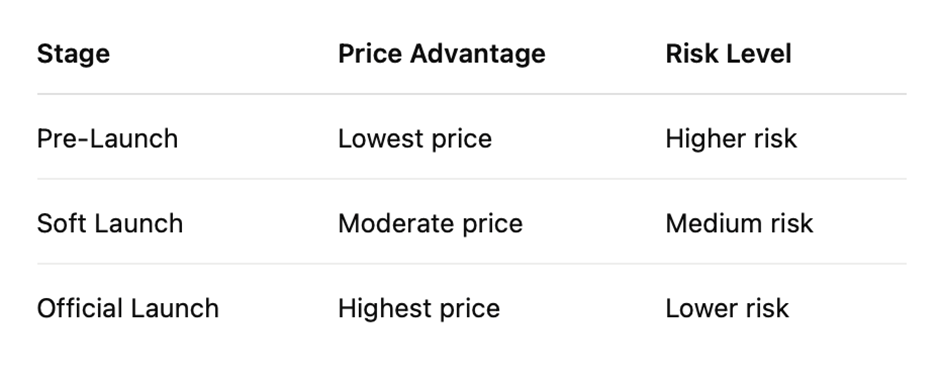
Example:
A project that launches at ₹1 Crore during official launch may be available at:
• ₹80–85 Lakhs during pre-launch
• ₹90–95 Lakhs during soft launch
This is why many investors try to enter early.
The right stage depends on your investment goal and risk tolerance.
• You want the lowest price
• You trust the developer’s track record
• You are investing for long-term appreciation
• You want moderate risk with good pricing
• You want better project clarity
• You want a mix of safety and appreciation
• You want maximum security and transparency
• You prefer to see the project physically before investing
• Price is not your primary concern
Regardless of the stage, buyers should always verify:
• RERA Registration
• Developer track record and past projects
• Land ownership and approvals
• Construction timeline
• Payment plan and hidden costs
These checks help avoid legal and financial complications later.
Understanding the difference between pre-launch, soft launch, and official launch projects can help buyers enter the market at the right time. Early-stage investments can offer strong price advantages and appreciation, while later stages provide more clarity and lower risk.
The key is to balance price, risk, and developer credibility before making a decision.
Whether you are a first-time homebuyer or a real estate investor, knowing these stages will help you make a more informed property investment.
