
Investing ₹1 crore in Navi Mumbai today presents a very different challenge from simply choosing a property in a promising location. With the region’s infrastructure and residential landscape evolving, investors must decide where their capital can deliver the most suitable combination of appreciation potential, rental income, liquidity and risk.
Three locations frequently considered in this conversation are Ulwe, Pushpak Nagar and Panvel.
All three have exposure to Navi Mumbai’s wider development story, but they are not identical investment propositions. Ulwe offers access to an evolving airport-linked residential corridor. Pushpak Nagar presents an emerging-location opportunity that may require a longer holding period. Panvel provides exposure to a more established residential and transport centre.
The right choice depends on what the investor wants from the property.
Is the objective to earn rental income immediately? Build wealth over the next decade? Purchase a home that can be used by the family? Or invest in an emerging location before its development matures?
This article compares the three locations through these questions and explores how an investment budget of ₹1 crore could be evaluated.
Ulwe has become an important consideration for buyers evaluating residential property within the wider airport-influenced development corridor.
Its appeal comes from the potential combination of airport access, regional connectivity and a growing residential ecosystem.
For investors, the central question is whether a particular property offers enough value at today’s price to justify its future appreciation expectations.
Ulwe may appeal to buyers who want exposure to the airport-led growth narrative while prioritising a location that already has residential development and everyday activity.
Potential advantages
Potential risks
Ulwe may suit investors looking for a balance between emerging-market potential and existing residential activity, provided the selected property is competitively priced.
Pushpak Nagar is often considered by investors seeking exposure to the future development of the wider airport corridor.
Its proposition is different from investing in a fully established neighbourhood. The potential upside is linked to the development of supporting infrastructure, residential occupancy, commercial activity and daily amenities.
This can make the location attractive to investors willing to hold for a longer period. However, it also introduces uncertainty about how quickly the market will mature.
Potential advantages
Potential risks
Pushpak Nagar may suit investors who are comfortable with uncertainty and do not need immediate rental income or a quick resale.
Panvel offers a different investment proposition because its appeal is supported by an existing residential and transport ecosystem, alongside its exposure to future infrastructure.
The area serves a wider regional population and provides access to established services, transport links and residential communities.
This means investors can evaluate both present-day utility and future development potential.
Potential advantages
Potential risks
Panvel may appeal to investors who want a balance between current usability and longer-term growth potential.
Comparing Ulwe, Pushpak Nagar and Panvel
The following comparison is a qualitative assessment, not a ranking of guaranteed returns.
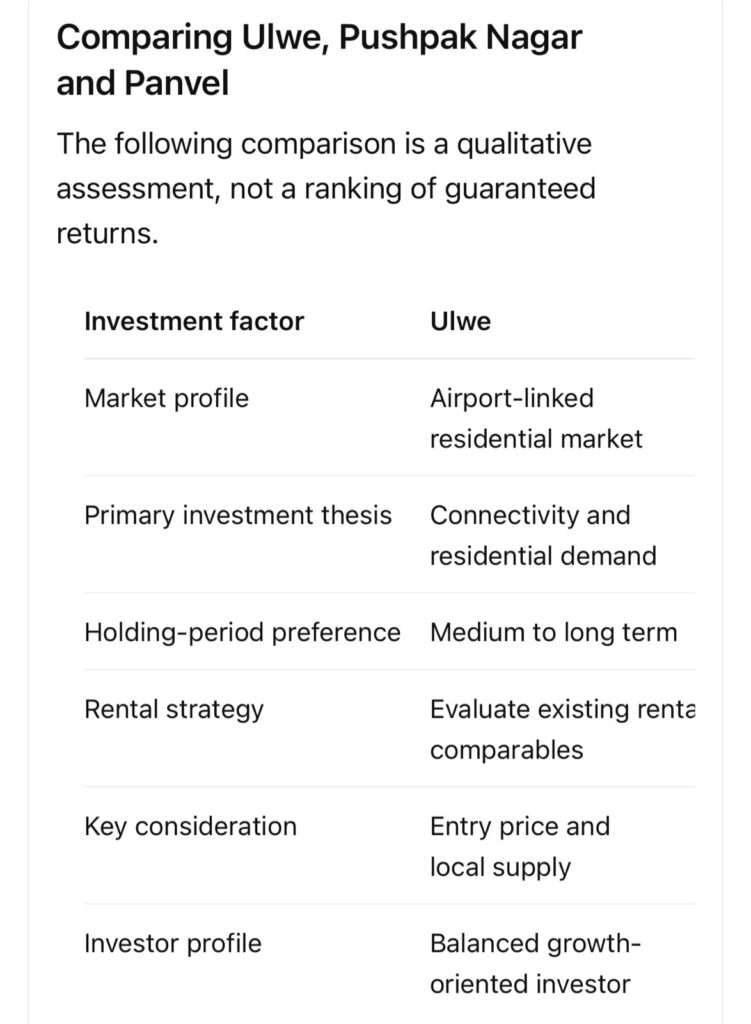
No locality is automatically the best choice. The quality of the property, its legal status, the price paid and the investor’s financial requirements can outweigh the difference between the three locations.
The first step is to distinguish between the headline property budget and the total investment budget.
A buyer spending the entire ₹1 crore on the quoted property price may still need additional funds for stamp duty, registration, brokerage where applicable, furnishing, repairs and other transaction costs.
If ₹1 crore is the total amount available, the maximum property purchase price should be lower than ₹1 crore. The exact amount depends on the applicable charges and the property transaction.
A prudent investor should also retain a financial buffer rather than using every available rupee for the purchase.
Option 1: Prioritise Ulwe
An investor considering Ulwe should begin by identifying the preferred property format, such as a compact apartment for rental demand or a larger home for future end-user resale.
The next step is to compare properties in the same micro-location. This includes checking carpet area, building quality, possession status, maintenance, transport access and current comparable rents.
Rather than selecting the largest apartment available within the budget, the investor should assess which configuration has the strongest combination of affordability, usability and potential resale demand.
The objective is to purchase a property that can remain attractive to future homebuyers, not simply one that benefits from a broad airport-related narrative.
Option 2: Prioritise Pushpak Nagar
An investment in Pushpak Nagar should begin with due diligence on the specific project or plot.
The buyer should verify the legal status, applicable approvals, possession or development timeline, road access, utility availability and the actual progress of the surrounding neighbourhood.
It is also important to determine how long the investor can hold the property without relying on rental income.
If the investment depends primarily on future development, the purchase price should leave sufficient room for uncertainty. A longer holding period does not automatically make an expensive property a good investment.
Option 3: Prioritise Panvel
In Panvel, investors should compare the established residential environment with the development prospects of the specific micro-market.
Properties close to useful transport links, employment centres and everyday amenities may appeal to a broader set of buyers and tenants. However, these advantages should be reflected in the price paid.
An investor should compare ready-to-move and under-construction properties on a total-cost basis, taking into account possession risk, rental income during the holding period and any additional expenses.
The aim is to identify a property whose current utility and future potential justify the investment.
A ₹1 Crore Property Investment Is Not Just About Appreciation
Investors frequently focus on the future selling price. But the actual financial outcome depends on several variables.
Capital appreciation is the increase in the market value of a property over time.
It depends on the purchase price, local demand, infrastructure delivery, competing supply, project quality and the wider economic environment.
An investor should avoid assuming that past growth rates will continue at the same pace.
Rental income can help offset maintenance costs, financing expenses and other recurring outgoings.
However, gross rent is not the same as net rental income. Vacancy periods, repairs, society charges borne by the owner, property management and taxes can reduce the amount received.
For a fair comparison, investors should calculate the expected net yield using realistic rent estimates.
Liquidity refers to how easily an asset can be sold without an excessive price reduction or a prolonged selling period.
A property in a location with broader end-user demand may be easier to resell than a property dependent mainly on future speculative demand. However, actual liquidity depends on the specific project, pricing and prevailing market conditions.
Property ownership involves costs beyond the initial purchase.
These can include loan interest, maintenance, insurance, repairs, property taxes and transaction expenses. Investors should account for these costs when comparing real estate with alternative investments.
A Simple Illustration: What Could ₹1 Crore Become?
Consider a hypothetical investment of ₹1 crore in a property. The following scenarios show the effect of different annual appreciation rates over ten years.
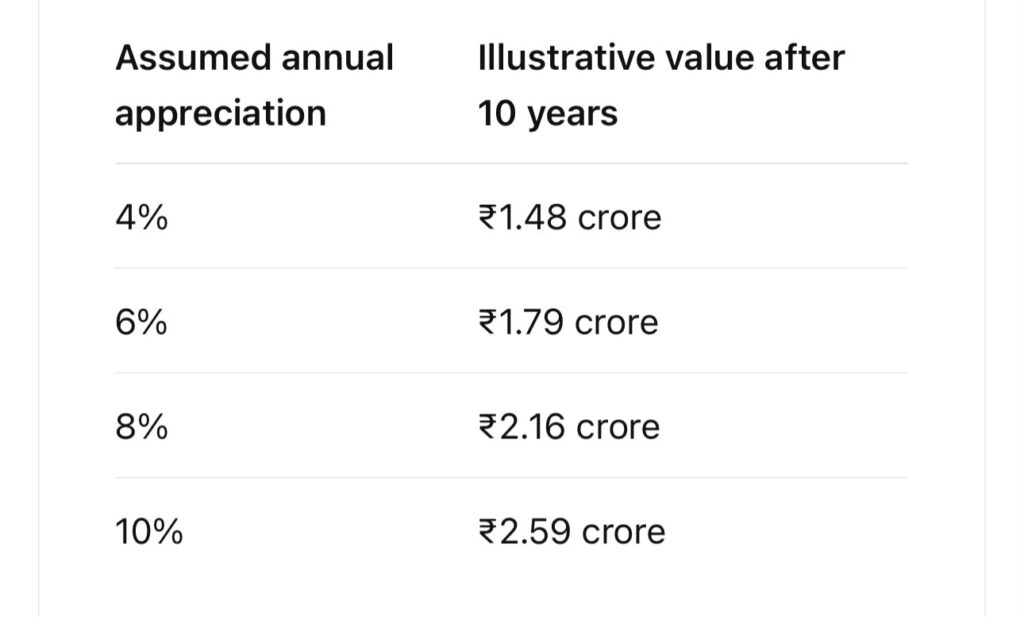
These figures are mathematical illustrations based on annual compounding. They are not forecasts for Ulwe, Pushpak Nagar or Panvel.
They exclude rental income, financing costs, taxes, maintenance, transaction costs and inflation. Actual property values can grow unevenly, remain flat or decline.
The illustration highlights why entry price matters. Even a small difference in the rate of appreciation can produce a meaningful difference in long-term value, but the higher assumed rate should never be treated as guaranteed.
The answer depends on the investment objective.
Choose Ulwe for further evaluation if: you want exposure to the airport-linked residential corridor and can identify a property with credible demand, practical connectivity and a reasonable purchase price.
Choose Pushpak Nagar for further evaluation if: you have a longer holding period, can tolerate development uncertainty and have independently verified the project’s legal and infrastructure status.
Choose Panvel for further evaluation if: you value an established residential and transport environment alongside the possibility of benefiting from future regional growth.
These are starting points for analysis, not substitutes for property-level due diligence.
Questions to Ask Before Investing ₹1 Crore
Before finalising a property, investors should ask:
These questions help turn a location-level investment idea into a practical property decision.
Invest According to Your Strategy, Not the Hype
Ulwe, Pushpak Nagar and Panvel represent three different ways to approach Navi Mumbai’s real estate market.
Ulwe offers exposure to an evolving airport-linked residential corridor. Pushpak Nagar may appeal to investors willing to wait for a developing neighbourhood to mature. Panvel combines an established urban environment with wider regional growth potential.
With a ₹1 crore budget, the strongest investment is not necessarily the one with the most ambitious appreciation story. It is the one that aligns with your holding period, risk tolerance, rental requirements and total acquisition budget.
A carefully selected property with sustainable demand and a sensible entry price can be a more compelling investment than a seemingly promising location purchased at an excessive premium.
Planning to invest ₹1 crore in Navi Mumbai? PropAdvisor can help you evaluate micro-markets, compare property opportunities and assess investment decisions based on your objectives.
